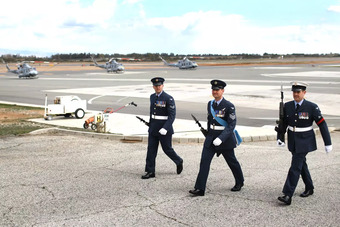
The UK retains two chunks of Cyprus for military and spying purposes, which are under the control of a Kafkaesque regime. Declassified went to investigate what are, in effect, British colonies.
By MATT KENNARD
31 January 2023
- UK military controls 3% of Cyprus landmass
- Executive power in the UK areas resides wholly in Ministry of Defence-appointed military officer
- MoD in London ignores interview request, but press officer in Cyprus apparently knew Declassified was there
- UK military sends alert across territory over presence of Declassified journalist
- Turkish soldier greets Declassified at RAF base in Cyprus despite MoD claiming no foreign personnel based there
Driving from the outskirts of Limassol, Cyprus’s second city, into British territory is not a normal border experience.
There are no officials checking passports, no signs, no flags. There is, in fact, nothing that would indicate you were crossing from the Mediterranean island’s sovereign territory to another country’s land.
The silent border is probably by design. Northern Cyprus has been illegally occupied by Turkey since its 1974 invasion, and it remains a controversial political issue. All along the northern border Turkish flags beam out from the hills.
The British colony generates none of the same animus and that may be because of its low-key – or non-existent – profile.
When Cyprus gained its independence from Britain in 1960, the former imperial power retained two significant chunks of the island. It had been under UK dominion since 1878 when it supplanted Ottoman rule.
The two chunks were named Sovereign Base Areas, or SBAs, but they weren’t just military bases. Together they comprise 98 square miles, or 3%, of the land area of Cyprus. This is 23 times larger than Gibraltar, another British overseas territory in southern Spain, at the other end of the Mediterranean.
There are huge military and intelligence installations on both of the Cyprus SBAs, but most of the land is not for military usage.
Akrotiri, named the Western SBA, directly abuts Limassol, and in the east, close to the UN-administered “buffer zone” with northern Cyprus, sits Dhekelia, the Eastern SBA.
The 1960 Treaty of Establishment also provided the UK with the continued use of certain facilities within Cyprus proper – known as Retained Sites – and for the use of specified training areas.
Because of the non-existent border, I have to guess when I actually enter Akrotiri, but once I’m sure I’m in, I take the road that leads down the territory’s main peninsula that juts south into the Mediterranean. Directly to the south is Sinai, Egypt while directly east is Tripoli, Lebanon: Cyprus has been coveted by imperial powers from time immemorial because of its strategic location.
When on British land, the first thing immediately noticeable is its dilapidated state. On the sides of the road are piles of rubbish, tarpaulin blows in the wind over shuttered kiosks and makeshift lakes spread out on both sides. Abandoned bollards are strewn across the ground.
The first establishment along the road is a bar and restaurant named Oasis which overlooks Limassol Bay. I get out of the car and make my way on to the beach, which has grey-brown sand covered with stones. Half a dozen people sunbathe. In the near-distance, in Cyprus proper, the Limassol docks rise into the sky.
Inside Oasis, I get my first taste of what would prove a theme of the next few days. I ask two older British ladies sitting at a table overlooking the beach if they know anything about the SBAs. “I know all about the SBAs but we don’t want to comment,” one says. And that is that.
Back in the car I carry on down the coastal road, which turns quickly into a dirt track, covered in large puddles and mud banks, which really require a 4×4 to navigate.
The next place on the road is Nissos Beach Bar, which has been shuttered and is covered in MDF. To my right, flamingos are feeding in Limassol Salt Lake. Tourists are walking alongside it. Another British couple, who again don’t want to give their name, are pointing at the flamingos. “I didn’t know we were in Britain,” one says. “I did know there was a base, but not that this lake and area is British, that’s really strange.”
‘No difference’
At another bar on the coastal road, finally a local agrees to speak to me, but, again, he will not give his name.
The man, who works at the bar and lives in Limassol, will answer some questions but only if it is not easy to identify him. He is English-Cypriot and has spent his life in Cyprus apart from a decade working in London, he tells me.
“The base is off limits to us, but the areas surrounding the base, which is considered the UK, it’s just like living in Cyprus,” he says. “There’s no difference really.” He adds: “It’s policed by the SBA, so the British Army have their own police force. That’s basically the only difference.”
The SBA police force, which operates across the British territory, is wholly funded by the Ministry of Defence.
He continues: “If you didn’t pay attention, you wouldn’t have a clue. There’s no actual border, you don’t have to go through any crossing. Most people don’t even know. And others just don’t accept it’s not Cyprus.”
I ask about the makeshift road his bar sits on.
“This particular street is just restaurants at the minute, which is going to change soon,” he says. “They’re planning on fixing the road, possibly opening some kiosks. They’re going to do a cycle path, a walking path, proper parking spaces, which will increase the amount of people coming to the area, which means they will have to increase the policing as well.”
He says that the majority of the people on the SBAs are locals. “There’s Greek Cypriots that work on the base; and the police force, the majority of them are Greek Cypriots. The people that are on the streets and the road, most of them are Cypriots. I know above them they have some British people working there, but the majority are Cypriots”.
Continue reading at www.defenddemocracy.press